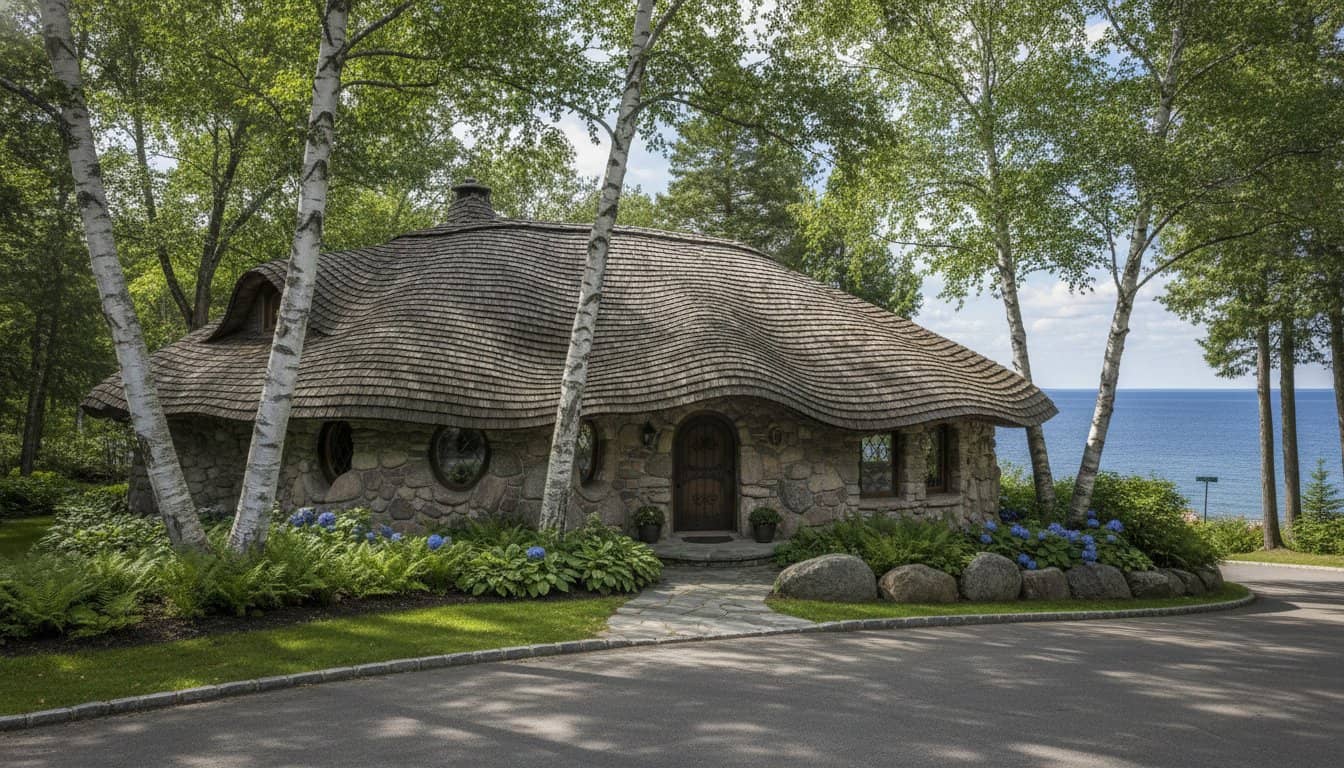
The homes known as mushroom houses are remembered for their whimsical silhouettes, but their defining idea is more grounded: architecture shaped by natural forms and materials. Exploring Earl Young mushroom houses history means looking beyond the nickname to the self-taught designer’s approach, from the way stone and boulders shaped each house to rooflines that seem to settle into the landscape.
These distinctive homes invite stories. Their rounded forms and storybook appearance can make dates, materials, and anecdotes sound equally certain, even when they need closer checking. A careful history separates recognizable architectural features from details that require reliable documentation.
This article traces the broad chronology of Young’s work and explains recurring design choices, including natural stone, expressive eaves, and prominent chimneys. It also shows how to verify specific dates and claims. With that context, the houses become more than a charming nickname: they reveal a considered design philosophy rooted in the character of each site.
Key Takeaways
- Learn who Earl Young was and how to place his design work in a broad, carefully verified chronology.
- Recognize the forms and materials that give the houses their distinctive character, while checking claims about specific features.
- Use the Earl Young mushroom houses history to separate documented architectural details from stories built around the nickname.
- Check dates and anecdotes against primary records and reputable historical or architectural sources before repeating them.
- See how Young’s design choices shaped a recognizable architectural identity and why the houses continue to draw interest.
Earl Young mushroom houses history: who was the designer?
The “mushroom houses” are homes associated with Earl A. Young, a designer whose distinctive buildings pair expressive rooflines and irregular forms with prominent stonework. The nickname describes their storybook-like appearance; it isn’t, by itself, proof that the houses belong to a formally defined architectural style. Understanding Earl Young mushroom houses history starts with separating that familiar label from documented details of Young’s life and work.
What is an Earl Young mushroom house?
Seen together, the houses are recognizable for low or curved roof profiles, textured stone surfaces, and shapes that avoid a uniform, boxlike outline. These features can make the buildings seem to grow from their surroundings, helping explain why people use names such as “mushroom houses” and “gnome homes.” The nickname is useful shorthand, but it shouldn’t replace a description of the actual design. Individual houses vary, so a feature associated with the group shouldn’t automatically be attributed to every one.
What is known about Earl Young’s early life and work?
Biographical accounts identify Young as having been born in 1889 and dying in 1975. He attended university for one year before leaving, and he was not a registered architect. He worked primarily as a realtor and insurance agent while developing a distinct approach to residential design. For a compact overview of the available biographical details, see the Earl Young biography. Check specific dates and career milestones against reliable historical records before publication.
The broad chronology places the beginning of Young’s building work around 1918 or 1919, continuing for more than five decades until his death. That span gives useful context, but it isn’t a complete project-by-project timeline. Claims about the first house, the order of individual commissions, or precisely how Young developed his methods call for stronger documentation than a repeated anecdote.
Young’s buildings are often described through their relationship to natural forms and materials, particularly stone and boulders. That description helps explain their visual character, but it doesn’t prove that every house followed the same construction recipe. When checking a specific building, look for records that identify its materials and date rather than assuming details from its nickname or a nearby example.
Earl Young was a self-taught designer whose distinctive houses are remembered for expressive forms and natural-looking stonework. That combination, rather than the whimsical nickname alone, is what makes the buildings recognizable.
How Earl Young’s mushroom houses developed over time
The surviving story is clearer in broad milestones than in a complete, house-by-house timeline. Accounts place Young’s building career around 1918 or 1919 and say it continued until his death in 1975. That period frames the work, but it doesn’t establish the design or construction date of every house now associated with his name.
Which dates and milestones define the houses’ history?
A useful chronology separates career dates from dates tied to specific buildings. The available historical summary identifies 1924 as the year Young began a development of his own, a milestone in his building work. It does not, by itself, confirm which individual house came first or when each design was completed. For those details, look for property records, dated photographs, building documents, or a reputable historical account tied to the specific house.
Totals also deserve care. Published accounts don’t always count the same kinds of structures, so a figure may refer to houses alone or include other buildings. Before treating a total as definitive, check what the source counted and whether it refers to buildings designed, built, or still standing.
How did the designs evolve?
Across the houses, continuity is easier to describe than to assign to particular years. Their recognizable character comes from varied roof profiles, substantial stonework, and forms that respond to individual sites. The historical society’s house-history resource offers context for Young’s design and use of natural materials, but a general description shouldn’t be mistaken for a dated record of every building.
Young is often said to have worked without blueprints, shaping designs around a site and selected boulders. This account helps explain why the houses can feel individually composed rather than repeated from a standard plan. Still, a claim about his working method isn’t evidence of how a particular home changed over time. Later alterations may also affect what visitors see today.
For a reliable comparison, start with a dated photograph or building record, then note visible features such as roof shape, stone placement, and additions. Separate what the record confirms from what the building’s appearance suggests. This keeps Earl Young mushroom houses history grounded: the chronology establishes when his work unfolded, while careful comparisons reveal design relationships without inventing a neat progression from one “early” or “late” style to another.
What makes the mushroom houses’ architecture distinctive?
Their character comes from a striking relationship between roof, wall, and stone. Low or gently curved rooflines can make a house seem tucked into its surroundings, while broad eaves and exposed rafters emphasize the roof’s shape. Irregular outlines and varied stone surfaces keep the façades from feeling like repeated versions of a standard plan. These are recurring design cues, not a checklist every building must meet.
Here, “organic appearance” describes the visual effect of forms and materials that seem to respond to a site. It doesn’t assign the houses to a formally verified architectural movement. An account of Young’s mushroom houses offers additional context on the design. For claims about a particular home, building-specific records remain the best guide.
How do natural materials shape the houses?
Stone gives the buildings much of their visual weight and texture. Descriptions of Young’s work identify limestone, fieldstone, and large glacial boulders among the materials used, with stone also prominent in fireplaces and chimneys. Cedar-shake roofs and exposed rafters contribute another layer of texture. These are useful patterns to look for, but a general description of Young’s buildings doesn’t confirm that every material appears in every house. Check photographs or records of an individual property before assigning it a specific material or construction detail.
Why do the forms suggest mushrooms or cottages?
The nickname follows the silhouette: a broad, low roof can appear to hover above sturdy walls, recalling a cap over a stem. Rounded or uneven lines and substantial stonework add to the cottage-like impression. “Mushroom house” is a vivid descriptive name, not proof of an official style label or a documented origin for the term.
| Visible feature or claim | What it supports |
|---|---|
| Low or curved roof profiles, wide eaves | A directly observable shape; the mushroom comparison is interpretation. |
| Stone walls, chimneys, or fireplaces | Visible use of stone; the exact stone type should be verified house by house. |
| Cedar-shake roofing or exposed rafters | Details identified in descriptions of Young’s work, but not necessarily universal. |
| “Mushroom” or “gnome” house | A popular nickname, not by itself a formal architectural classification. |
Read together, the materials and silhouettes explain why Earl Young mushroom houses history attracts attention: the buildings feel distinctive without being identical. Compare specific examples carefully, separating what can be seen from what a source documents.

How to separate documented history from mushroom-house lore
A memorable nickname can make a house easy to recognize, but it doesn’t establish an official architectural classification or explain who first used the name. Treat “mushroom house” as a popular description unless a reliable historical source documents a more specific origin. Apply the same care to stories about Young’s inspirations, design habits, or personal remarks. Repetition in visitor materials isn’t the same as independent evidence.
Which popular claims need careful sourcing?
Look closely at claims that sound vivid or unusually precise: the first house, an exact construction date, a particular boulder inspiring a design, or a quotation attributed to Young. Ask where the information first appeared and whether the source identifies a record, witness, or interview. For named houses, check whether the name appears in historical documentation or only in later descriptions. If an interpretation rests on a later account, attribute it rather than presenting it as settled fact.
How can readers assess a historical source?
Start with sources closest to the evidence, such as property or building records, archival photographs, contemporary documents, and preservation records. Then compare them with credible biographies and expert-authored historical accounts. A dependable source should make clear what is documented, what comes from someone’s recollection, and what is interpretation. If two reputable sources disagree, preserve that uncertainty instead of choosing the most colorful version.
As you check a detail in Earl Young mushroom houses history, use this quick list:
- Name: Is the house name tied to a historical record, or does it appear only in later descriptions?
- Date: Does the source distinguish design, construction, and later alterations?
- Material: Is the material confirmed for that specific building, rather than generalized across Young’s work?
- Intention: Is a statement about Young’s motives supported by his own words or a clearly identified account?
- Agreement: Do independent historical sources support the claim, or repeat the same unattributed story?
This approach doesn’t strip the houses of their charm. It helps readers understand the documented record and later lore for what they are. If you’re planning a visit to explore the architecture, check dates, access details, and any visitor guidance before you go.
Earl Young’s mushroom houses history and their lasting architectural legacy
Young’s architectural identity rests on a clear set of choices: expressive rooflines, irregular forms, and stone used as a defining part of the building’s character. Rather than relying on one repeated house plan, the designs feel distinctive through the relationship between a structure and its individual site. That combination makes the houses recognizable while leaving room for meaningful differences from one example to another.
Why does Earl Young’s architectural work still draw interest?
The appeal is both visual and architectural. A low, sweeping roof against textured stone creates a silhouette that stands apart from more conventional residential forms. For architecture-minded readers, the houses offer a useful case study in how shape, material, and site can work together to create a memorable identity without making every building identical. Their appearance invites interpretation, but claims about Young’s influence on later designers should be supported by specific evidence rather than inferred from resemblance alone.
Interest is reflected in more than visitor attention. A historical society museum preserves archives and artifacts related to Young, and its museum building received a Governor’s Award for Historic Preservation in 2025. These are concrete signs of ongoing historical and preservation attention. They don’t establish that every house has the same preservation status, so claims about an individual property should be checked separately.
Where can curious readers continue exploring?
For deeper research, follow source notes back to archival material, dated photographs, property records, and credible architectural histories. Compare accounts, especially when they make claims about a house’s construction date, materials, or Young’s intentions. The Earl Young mushroom houses history is strongest when documented facts remain distinct from later interpretations, even when those interpretations help explain the buildings’ enduring charm.
Readers interested in the wider cultural life around architecture can explore arts and cultural experiences. The lasting lesson is simple: the houses’ distinctive identity is grounded in recognizable design choices, while individual stories and meanings still deserve careful verification.
Keep exploring the stories behind distinctive design
The Earl Young mushroom houses history reveals more than a collection of memorable silhouettes. Young’s recognizable approach combined expressive forms and natural-looking materials, while the nickname itself remains a popular description rather than proof of a formal architectural classification. Checking dates, materials, and anecdotes against dependable records helps keep documented history distinct from later interpretation.
That careful perspective makes each house more interesting, not less. Look closely at how rooflines, stonework, and individual forms come together, and stay curious about which details are confirmed for each building. The most rewarding stories leave room for both evidence and thoughtful appreciation.
For a comfortable place to unwind after exploring distinctive architecture, Edgewater Inn offers one- and two-bedroom suites with fully equipped kitchens and private balconies with water views. Explore Edgewater Inn’s waterfront suites and plan a stay with space to enjoy the experience at your own pace.
Frequently Asked Questions
Who was Earl Young?
Earl A. Young was a self-taught designer best known for the distinctive houses associated with his name. Biographical accounts give his lifespan as 1889 to 1975 and report that he attended university for one year before leaving. He worked primarily as a realtor and insurance agent, rather than as a registered architect. The Earl Young mushroom houses history is tied to his unusual design approach, though specific career details and anecdotes should be checked against dependable sources.
When were Earl Young’s mushroom houses built?
Young’s building career is generally placed from around 1918 or 1919 until his death in 1975, but that span doesn’t mean the houses were built as one project or at identical dates. A particular home may have separate design, construction, and alteration dates. For an individual building, consult historical or preservation records and note which event each date describes. Use “about” or “circa” only when a reliable source itself supports an approximate date.
Why are Earl Young’s houses called mushroom houses?
The nickname refers to the houses’ memorable silhouettes, especially low or curved rooflines that seem to spread over substantial walls. It’s a descriptive label, not proof that Young formally classified his work as a “mushroom” architectural style. The available information establishes the nickname as a later popular description, but doesn’t confirm exactly who first used the phrase or when. Treat claims about its origin as uncertain unless a credible historical source documents them.
What materials did Earl Young use in his houses?
Descriptions of Young’s work identify natural stone, including fieldstone, limestone, and large boulders, along with details such as cedar-shake roofs and exposed rafters. These materials contribute to the houses’ varied textures, but they shouldn’t be assumed to appear in every building. If you’re researching one specific house, check building records, preservation documentation, or clear historical photographs. Distinguish a visually suggested material from one confirmed by a reliable source.
Did Earl Young have formal architectural training?
Biographical accounts describe Young as self-taught and report that he studied at university for one year before leaving. They also identify him as a designer, not a registered architect. These details offer context for his career, but shouldn’t be stretched into unsupported stories about how he learned particular techniques. Before publication, compare biographical claims with credible historical sources, especially when accounts differ or don’t explain the records behind them.
Are all of Earl Young’s houses architecturally alike?
No. Recurring features, such as expressive rooflines, irregular forms, and prominent stonework, create a recognizable family resemblance, but they don’t make every house identical. Materials and visible details can vary between buildings, and later alterations may affect what remains today. Compare documented examples rather than applying one house’s features to all the others. That distinction helps keep Earl Young mushroom houses history grounded in evidence while leaving room to appreciate each building’s individual character.