

What if the most productive retreat agenda leaves room for the moments that aren’t on the agenda? When comparing corporate retreat locations, the schedule matters as much as the setting. Pack in too many meetings, and conversation and rest can disappear; leave the day too loose, and important decisions may never get made.
It’s a familiar balancing act. A generic schedule rarely reflects your team’s goals, group size, or working style, and it can be hard to know which sessions deserve the most time.
This flexible, copy-ready corporate retreat agenda helps you bring focused work, thoughtful discussion, restorative breaks, and shared time into a single plan. You’ll also find ways to tailor the schedule and give decisions clear owners and follow-up steps, so good conversations lead somewhere.
At Edgewater Inn, meeting and event spaces can anchor focused sessions, while professionally managed suites with fully equipped kitchens and private water-view balconies offer comfortable settings for informal connection. Ahead, you’ll find a practical framework for shaping a retreat that feels purposeful without feeling overplanned.
Key Takeaways
- Start with two or three retreat outcomes, then choose sessions that serve those goals rather than filling every hour.
- Build a flexible rhythm of focused work, discussion, breaks, and shared time so the schedule supports both progress and connection.
- Use the copy-ready agenda as a framework, adapting its blocks to your team’s goals, travel needs, and energy.
- When comparing corporate retreat locations Northern Michigan offers, consider how meeting spaces and comfortable suite lodging can support the flow of your retreat.
- Before participants leave, capture each decision, its owner, and the next follow-up step to carry retreat conversations into action.
What Should a Corporate Retreat Agenda Accomplish?
A corporate retreat agenda turns retreat goals into a sequence of purposeful sessions. Unlike a standard meeting schedule, it makes room not only for decisions and updates, but also for reflection and connection. Before choosing activities, agree on two or three outcomes the team should leave with. That focus helps keep the day useful without filling every open moment.
Team-building activities can be one way to improve team effectiveness, but an activity earns its place on the agenda when it serves a clear purpose. Use this simple test before adding another discussion or exercise: can you connect it to a stated team outcome?
Set retreat goals before filling the schedule
Begin by naming what the retreat should make possible. Are you aiming to reach a decision, build shared understanding around a new direction, or strengthen relationships across teams? Choose a small number of priorities so participants can give each one meaningful attention.
For goals that need a measurable result, use the SMART framework as an optional check: is the goal specific, measurable, achievable, relevant, and time-bound? Then connect each goal to a session purpose and a concrete output. For example, a session intended to clarify priorities might produce an agreed list of initiatives and a person responsible for each next step. The output makes it easier to see whether the session did its job.
Decide who the agenda needs to serve
A retreat can bring together leaders who know one another well, colleagues from different functions, or a mix of roles and experience. Consider participants’ familiarity, energy, and expectations when choosing formats. A group that needs shared context may benefit from a full-team conversation, while a detailed planning discussion may be more productive in a smaller group.
Separate the sessions everyone needs to attend from discussions that can happen in focused breakouts. This protects time for shared understanding without requiring every participant to sit through every working conversation. Before finalizing the schedule, invite participants to share their priorities or questions. Their input can reveal concerns planners haven’t considered and help shape a retreat that feels relevant to the people in the room.
With outcomes, participants, and session purposes in view, the agenda becomes more than a timetable. It becomes a thoughtful framework for deciding what deserves the team’s attention and what the team should be able to carry forward afterward.
How to Build a Corporate Retreat Agenda That Balances Work and Connection
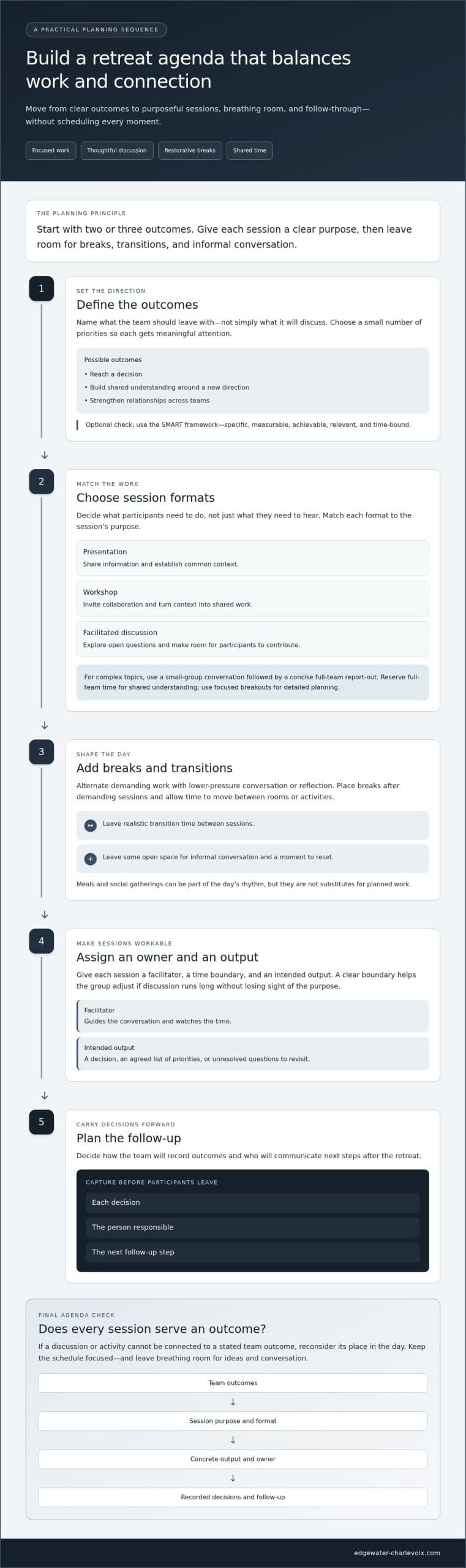
A useful agenda gives the team a clear path through the day without making every moment feel prescribed. Build it in this order, then check that each session contributes to the outcomes you identified.
- 1. Define outcomes. Name the decisions, shared understanding, or relationships the retreat should support. Describe what participants should leave with, not simply what they’ll discuss.
- 2. Choose session formats. Match the format to the work: presentations share information, workshops invite collaboration, and open discussions surface questions. Use smaller groups when everyone needs room to contribute.
- 3. Add breaks and transitions. Alternate demanding work with lower-pressure conversation or reflection. Leave realistic time to move between sessions, and don’t schedule every minute.
- 4. Assign owners. Give each session a facilitator, a time boundary, and an intended output, such as a decision, a list of priorities, or unresolved questions to revisit.
- 5. Plan follow-up. Decide how the team will record outcomes and who will communicate next steps after the retreat.
A clear session purpose makes an agenda block easier to evaluate: if it doesn’t advance a stated outcome, reconsider its place in the day. This simple test can keep the schedule focused while leaving breathing room for ideas and conversation.
Choose session formats that match the goal
Think about what participants need to do, not just what they need to hear. A short presentation can establish common context; a workshop can turn that context into shared work; and a facilitated discussion can help a team explore open questions. For a complex topic, a small-group conversation followed by a concise full-team report-out can make space for more voices while bringing everyone back to the same decisions.
Set a clear boundary for each session. A facilitator can guide the conversation, watch the time, and capture the intended output. This makes it easier to adjust if discussion runs long without losing sight of the session’s purpose.
Build in breaks and informal conversation
Place breaks after demanding sessions, and allow time for transitions between rooms or activities. These intervals help the day feel more manageable and give participants a moment to reset. Leave some open space, too. Informal conversation can strengthen connection, but meals and social gatherings work best as part of the day’s rhythm, not as substitutes for planned work.
When evaluating corporate retreat locations Northern Michigan, consider how meeting areas and suite lodging can support that balance. At Edgewater Inn, fully equipped suite kitchens and private water-view balconies offer settings for relaxed conversation alongside structured retreat time. Review the one- and two-bedroom suite accommodations as you plan a setting that suits your agenda.
One-Day or Multi-Day Retreat? Choose a Format Your Team Can Use
The right retreat length depends on the work ahead, how much travel participants face, and the energy they’ll have for discussion. A one-day format can focus attention on a central decision; an overnight retreat gives the group more room to pause, reflect, and connect beyond formal sessions.
Think of an agenda template as a flexible framework, not a minute-by-minute rulebook. Keep its outcomes and essential sessions, then adjust pacing to suit the team and setting.
| Format | Best-fit purpose | Planning considerations | Trade-offs |
|---|---|---|---|
| One day | Addressing one central decision or a compact set of priorities | Account for travel, share a pre-read, and protect breaks | Less room for extended reflection or informal connection |
| Multi-day | Combining strategic work with reflection and relationship-building | Plan lodging, daily recaps, and a manageable pace across the stay | Requires more time away and coordination |
When a one-day retreat is the better fit
Choose a focused day when the team has one clear decision to make or a short list of priorities to resolve. Keep only the sessions that support those outcomes, and preserve breaks rather than squeezing in another topic. If discussion time is limited, send participants a concise pre-read so they arrive with the same context and can spend the day working through the questions that matter.
When to spread the agenda across multiple days
An overnight format can give strategic work and reflection their own space. For example, use the first day to explore a challenge and surface options, then begin the next with a brief recap before moving toward decisions and next steps. Close each day by noting what the team learned and setting priorities for the morning. That pause helps keep the schedule purposeful without making every gathering another formal meeting.
Additional time can also make informal connection feel more natural, especially when travel would make a single-day visit feel compressed. When comparing corporate retreat locations Northern Michigan offers, consider whether meeting space and suite lodging can support both focused sessions and comfortable downtime. Edgewater Inn’s one- and two-bedroom suites provide lodging alongside meeting and event spaces. For room setup and session flow, plan around the work each gathering needs to accomplish.
Copy-Ready Corporate Retreat Agenda Template for a Full Day
Use this schedule as a starting point, not a fixed prescription. The times are illustrative; adjust them to your team’s travel plans, priorities, and energy. Replace each sample output with something participants can leave with, and mark optional blocks clearly so you can shorten the day without losing its purpose.
Full-day schedule: from opening to closing reflection
| Time | Agenda block | Purpose | Facilitator | Expected output | Status |
|---|---|---|---|---|---|
| 8:30-9:00 | Arrival and informal welcome | Settle in and reconnect | Host | Participants ready to begin | Essential |
| 9:00-9:30 | Goals and working agreements | Align on outcomes and how the group will work | Retreat lead | Agreed goals and discussion norms | Essential |
| 9:30-11:00 | Focused work session | Address the retreat’s main question | Topic owner | Options, insights, or draft decision | Essential |
| 11:00-11:20 | Break and transition | Rest and reset before collaboration | Host | Participants refreshed | Essential |
| 11:20-12:15 | Collaborative workshop | Build on the morning’s work | Facilitator | Shared priorities or recommendations | Essential |
| 12:15-1:15 | Lunch and open conversation | Make space for informal connection | Host | Questions to carry into the afternoon | Essential |
| 1:15-2:30 | Small-group discussions | Explore questions or perspectives in depth | Group leads | Key themes and outstanding questions | Optional |
| 2:30-2:50 | Break | Restore energy | Host | Ready for synthesis | Essential |
| 2:50-3:45 | Reflection and synthesis | Connect ideas and confirm direction | Retreat lead | Decisions and open items | Essential |
| 3:45-4:15 | Close and next steps | Assign ownership and invite reflection | Retreat lead | Owners, follow-up steps, and participant reflections | Essential |
Customize the template without losing its purpose
Trade generic labels for your team’s real questions. If the goal is to agree on priorities, name the decision in the session block and specify the output, such as a ranked list or a documented choice. Add a materials field where preparation is needed, and name a facilitator for every working session. For a half-day, keep the opening, one focused block, a break, and a close. For a multi-day retreat, distribute the essential work and reflection across days, ending each with a recap and the next day’s priorities.
When comparing corporate retreat locations Northern Michigan offers, consider whether the setting supports focused sessions and restorative pauses. Explore retreat amenities and facilities as you plan the practical rhythm around your agenda.
Make the Agenda Work on Retreat Day and Choose a Setting That Supports It
A thoughtful agenda can still need adjustments once the team is together. Discussion may uncover a question worth exploring, or a session may reach its goal sooner than expected. A facilitator can keep the retreat on course by distinguishing essential sessions from optional blocks before the day begins. If a conversation runs long, shorten or move an optional activity rather than sacrificing a key decision, a break, or the closing review.
Keep the schedule useful when plans change
Build in a brief check-in during the day to ask whether the group is still working toward its intended outcomes. If priorities have shifted, the facilitator can clarify what needs attention now and what belongs in follow-up. Assign one person to record decisions and communicate schedule changes, so participants know what’s moved and why.
Before the group disperses, review each decision, the person responsible for the next step, and a follow-up date. Capture unresolved questions, too, with a clear owner for addressing them. This simple closing record helps turn a productive conversation into work the team can carry forward.
Plan the setting around the retreat experience
The setting should support both the formal agenda and the quieter intervals around it. Edgewater Inn offers meeting and event spaces alongside professionally managed suites, making it possible to bring structured work and comfortable lodging into one retreat plan. Suite kitchens can provide a practical place for informal conversation, while private balconies with water views offer a quieter setting between scheduled sessions.
As you compare corporate retreat locations Northern Michigan, consider how the spaces fit the way your team will move through the day, from focused discussion to time spent together outside the meeting room. Explore Edgewater Inn’s one- and two-bedroom suites as part of planning a stay that supports your retreat’s rhythm.
With a flexible agenda and a setting that gives work and downtime room to coexist, your team can stay focused without making the retreat feel overplanned. Explore Edgewater Inn’s meeting options as you shape a retreat that brings people together around meaningful work.
Shape a Retreat Your Team Can Carry Forward
A strong retreat agenda begins with a few clear outcomes, then gives each session a purpose, an owner, and room to breathe. Whether you choose a focused day or an overnight format, treat the schedule as a flexible guide and leave with decisions, responsibilities, and follow-up steps recorded.
For teams comparing corporate retreat locations Northern Michigan offers, Edgewater Inn brings meeting and event spaces, including the Bridgeview and Harborview rooms, together with professionally managed one- and two-bedroom suites. Fully equipped kitchens and private balconies with water views make space for relaxed moments between sessions, while the indoor/outdoor pool and high-speed internet add comfort and convenience to the stay.
Let the agenda reflect what your team needs to accomplish, and choose a setting that supports both purposeful work and meaningful connection. Explore Edgewater Inn’s meeting and retreat options as you plan your next gathering. A thoughtful schedule can help your team leave refreshed, aligned, and ready for what comes next.
Frequently Asked Questions
What should a corporate retreat agenda include?
A corporate retreat agenda should include the team’s goals, purposeful sessions, breaks, informal connection, and clear next steps. For each working session, note its purpose, facilitator, time boundary, and expected output. Include opening time to align on priorities and a close to capture decisions, owners, and follow-up dates. This helps participants understand not only what’s scheduled, but why each block matters.
How do you structure a corporate retreat agenda?
Structure the agenda around the outcomes the team needs, then place the sessions in an order that supports them. Open with goals and working agreements, move into focused work, and alternate demanding discussions with breaks or lower-pressure activities. Leave transition time between blocks instead of scheduling every minute. End by reviewing decisions, assigning owners, and recording follow-up steps while everyone is together.
How long should a corporate retreat last?
A retreat should last long enough to accomplish its goals without making the schedule feel crowded. A focused day may suit one central decision or a compact set of priorities. A multi-day format can create more room to separate strategic work from reflection and informal connection. Consider travel demands, available time, and participants’ energy, then choose the shortest format that gives essential conversations proper attention.
How much time should a corporate retreat agenda leave for breaks?
There’s no single break schedule that fits every retreat. Plan pauses around the demands of the sessions, allowing time to rest and transition before moving into the next activity. After a complex workshop or extended discussion, a break can help participants reset. Leave some unscheduled space, too. A retreat agenda should guide the day, not turn every moment into another programmed activity.
How do you make a corporate retreat agenda engaging?
Make the agenda engaging by giving participants varied ways to contribute. Pair information-sharing with collaborative workshops, open discussion, and smaller-group conversations where more voices can be heard. Connect each activity to a real team question or desired output, and invite participants to share priorities before the schedule is final. Build in informal conversation as well, so connection has room to develop beyond structured sessions.
Can a corporate retreat agenda template work for a hybrid team?
Yes, a template can work for a hybrid team if you adapt each session for both in-room and remote participation. Share materials in advance, state how remote colleagues can contribute, and assign someone to monitor questions or comments from online participants. Keep the session purpose and expected output clear for everyone. Test the meeting setup beforehand, and avoid relying on activities that only work face to face.
How do you measure whether a corporate retreat was successful?
Measure success against the outcomes the team set before the retreat. If the goal was to make a decision, record whether it was reached and who owns the next step. For shared understanding, capture agreed priorities and remaining questions. For relationship-building, gather participant reflections about what helped connection. When comparing corporate retreat locations Northern Michigan offers, also consider whether the setting supported the balance of focused work and informal time.


