

What if the strongest retreat pitch has less to do with the view and more to do with what your team can accomplish together? If you’re figuring out how to pitch a retreat venue to your boss, it’s understandable to worry the idea will sound like a leisure trip or pull people away from regular responsibilities. A clear business case can change that. Connect the retreat to company priorities, show how the agenda protects time for focused work, and make the venue choice easy to assess.
This guide will help you shape a concise proposal with specific goals, a practical agenda, transparent budget considerations, and a clear next step. You’ll also learn how to compare venues against the retreat’s needs, from meeting space to overnight accommodations. Edgewater Inn brings meeting and event spaces together with 60 one- and two-bedroom units, offering a practical example of how work sessions and an overnight stay can be planned in one setting. With a thoughtful plan, your proposal can show not just where the team will gather, but why the time away is worth taking.
Key Takeaways
- Start with the specific work challenge the retreat will address, then connect the intended outcomes to company priorities.
- Use a clear proposal sequence to make the purpose, format, venue fit, logistics, and evaluation easy to follow.
- Compare venues against the team’s needs, weighing practical evidence and trade-offs rather than relying on atmosphere alone.
- Learn how to pitch a retreat venue to your boss by anticipating concerns about time, budget, attendance, logistics, and results.
- Close with a defined scope, any open decisions, and straightforward next steps to help move an approved idea into planning.
How to Frame a Retreat Venue as a Business Decision
Begin with the work that needs attention, not a scenic setting or a list of activities. Perhaps a planning cycle has left priorities unresolved, a cross-functional project keeps stalling, or a distributed team needs dedicated time to align on decisions. Naming the challenge first helps leadership see the retreat as a response to a business need, rather than time away without a clear purpose.
Start with the business need, not the destination
Describe what the group needs to accomplish together and why the usual meeting rhythm makes that difficult. A retreat could give a project team uninterrupted time to map dependencies, or help department leads resolve competing priorities in one room. Be specific about the gap, but measured about what the event can achieve. A focused setting can support productive discussion; it can’t guarantee a particular business result.
Only after establishing the need should you explain why a retreat format and venue are suitable. Consider whether participants need a shared meeting space, overnight accommodations for a multiday schedule, or internet access for planned work. For example, a venue with meeting and event spaces alongside overnight suites can reduce the need to coordinate separate locations. Link each feature to the schedule or attendee experience, rather than presenting amenities as benefits on their own.
Purposeful work and downtime can both have a place. Set aside defined sessions for planning, collaboration, or team alignment, then leave reasonable breathing room between them. Informal conversations may help colleagues build familiarity, while a clear agenda ensures the event remains grounded in work. A brief explanation of the benefits of team building can help contextualize connection as one possible part of a broader retreat, not a substitute for business objectives.
Define outcomes leadership can assess
Choose deliverables that can be reviewed when the retreat ends. These might include a documented set of priorities, a project plan with owners, or decisions recorded with follow-up dates. Separate those immediate outputs from longer-term outcomes, such as whether a new process improves collaboration. The latter require follow-up after the retreat, so avoid presenting them as guaranteed results of the event.
To keep the proposal credible, explain how each output supports a current company priority and how you’ll capture it. Name who will document decisions, where the action plan will live, and when the group will revisit progress. This gives leadership a way to assess the value of the time spent together without relying on broad promises about morale or performance.
A useful success statement could read: “The retreat will produce an agreed set of quarterly priorities, a documented project plan with owners, and a follow-up date for reviewing progress.” Adapt the deliverables to the actual need; the point is to make success observable.
As you consider how to pitch a retreat venue to your boss, bring the recommendation into one sentence: “I recommend a focused retreat for the product and operations leads, using dedicated planning sessions to agree on quarterly priorities and leave with a shared action plan.” This states the purpose, audience, and desired result before the proposal moves into format and logistics.
Build a Retreat Proposal That Makes the Business Case
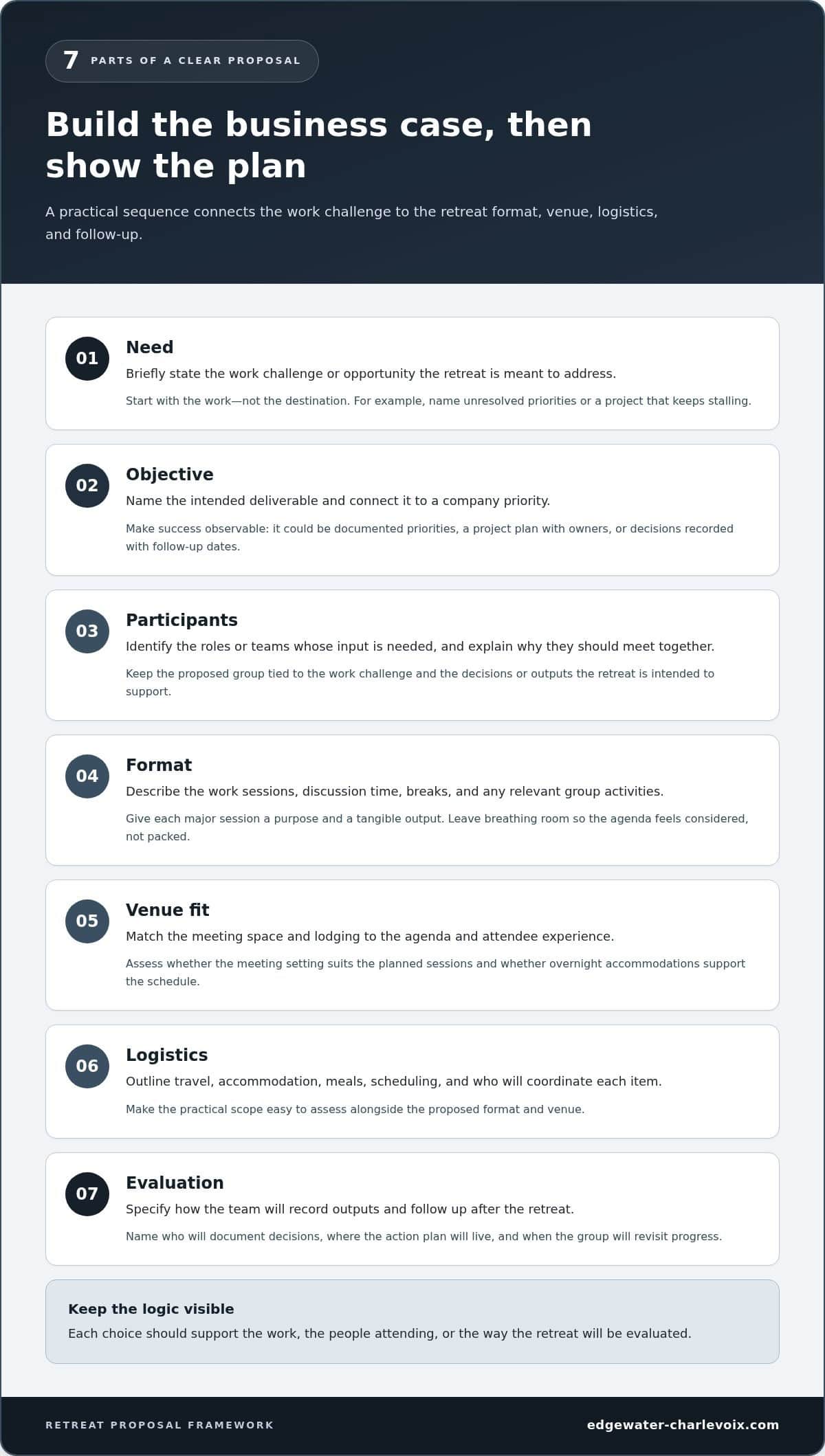
With the purpose established, shape the proposal so a decision-maker can follow the logic from business need to practical plan. A concise sequence keeps venue details in context: each choice should support the work, the people attending, or the way the retreat will be evaluated. This is the heart of how to pitch a retreat venue to your boss: make the rationale visible, then give leadership a clear view of the scope and trade-offs.
- Need: Briefly state the work challenge or opportunity the retreat addresses.
- Objective: Name the intended deliverable and how it connects to a company priority.
- Participants: Identify the roles or teams whose input is needed, and explain why they should meet together.
- Format: Describe the work sessions, discussion time, breaks, and any relevant group activities.
- Venue fit: Match meeting space and lodging to the agenda and attendee experience.
- Logistics: Outline travel, accommodation, meals, scheduling, and who will coordinate each item.
- Evaluation: Specify how the team will record outputs and follow up after the retreat.
Connect the agenda to the intended outcomes
Give every major session a purpose and a tangible output. A planning block might end with a draft roadmap; a discussion could identify unresolved decisions and assign follow-up owners. Add breaks and informal time deliberately, so the schedule feels considered rather than packed. Then explain why an off-site format supports the objective, such as bringing the relevant participants together for sustained discussion that’s difficult to fit into routine meetings.
Venue details should reinforce that reasoning. For instance, corporate retreat meeting rooms are one example of the information to assess: how the meeting setting aligns with the proposed sessions, and whether overnight lodging can make the schedule and attendee experience more cohesive.
Make the budget and trade-offs easy to understand
Present expenses as categories for internal research, not as guessed totals. Include venue, lodging, travel, and meals, and label each amount as confirmed or estimated. If an estimate depends on an assumption, state it plainly, such as the expected attendance or accommodation arrangement. This gives leadership a transparent basis for discussion without implying a rate or savings that hasn’t been established.
Offer two workable scopes where possible. A fuller option might include the complete participant group and planned overnight stay; a scaled alternative could narrow attendance or use a different format. Explain what changes in the agenda, logistics, and intended outputs, as well as what remains essential. Don’t attach an unsupported return-on-investment figure. Let the business need, deliverables, and clearly presented trade-offs make the case.
As you refine the lodging portion, review the available suite configurations as one way to think through how overnight accommodations may fit the proposed attendee experience. Edgewater Inn offers one- and two-bedroom suites, and guests can view individual units online before selecting one. Use the proposed group size and attendees’ needs to explain which configuration you’re considering, rather than assuming one arrangement suits everyone.
Compare Retreat Venues Against the Team’s Real Needs
A venue comparison helps leadership see why a setting fits the retreat, not just which option looks most appealing. Use the same few criteria for every candidate, and tie each one to the agenda. For example, a venue’s meeting space matters if it supports the planned work sessions; lodging matters if the schedule depends on participants staying overnight. Keep the comparison focused on evidence, trade-offs, and relevance to the team’s objective.
Evaluate meeting spaces and overnight accommodations together
Consider the meeting environment and the stay as parts of one plan. Assess whether the available space suits the session format, and whether the lodging arrangement supports the group and schedule. Edgewater Inn offers meeting and event spaces alongside 60 one- and two-bedroom units. Guests can view individual units online before selecting one that suits their needs. These details offer concrete points to compare against the team’s requirements. Consider how meeting space and lodging work together, without treating atmosphere as a substitute for practical fit.
Show the trade-offs without overwhelming your boss
Limit the comparison to criteria that could change the decision. Record the evidence for each option, the clearest advantage, and the main compromise. Avoid a long amenities inventory; a concise matrix makes it easier for leadership to see which venue best supports this retreat’s particular purpose.
| Criterion | Evidence to compare | Trade-off to note | Relevance to the retreat |
|---|---|---|---|
| Meeting-space suitability | Available meeting or event space, assessed against the planned sessions and format | A space may support the agenda well, while another may suit a different meeting style | Can participants carry out the planned work comfortably? |
| Lodging configuration | Types of overnight accommodations and how they align with the group’s arrangement | Different configurations may suit different attendee needs | Does the lodging support the schedule and stay experience? |
| Internet access | Internet access information and how it serves the retreat’s planned work | Connectivity needs depend on the sessions and participants | Can the team complete work that relies on online access? |
| Attendee comfort | Relevant features, such as the unit amenities, where they matter to the group | A feature is useful only if it supports the planned experience | Will the setting make the schedule practical and comfortable? |
For each candidate, use the same format and be candid about limitations. Edgewater Inn’s meeting spaces and suite options may align with a retreat that pairs group sessions with overnight stays; another option may fit a different format better. That distinction strengthens how to pitch a retreat venue to your boss: the recommendation is tailored to the team, not presented as a universal verdict. Close with the strongest fit and the trade-off leadership should weigh.
Prepare for Objections and Make the Pitch Easy to Approve
A sound proposal doesn’t sidestep leadership’s concerns. It makes them easier to weigh by pairing each question with evidence, a practical mitigation, or an honest trade-off. Keep the main pitch to a one-page summary or short presentation, with the detailed agenda, venue comparison, and budget assumptions ready as backup. That way, your recommendation is clear without burying the decision-maker in planning minutiae.
Answer common questions with evidence and options
Anticipate questions about time away, attendance, logistics, spending, and results. Respond with specific details from the proposal, rather than broad assurances. For example, show how each agenda block uses participants’ time and why those attendees need to work together. A focused list of roles and shared responsibilities can also make the invitation feel purposeful, not like a general perk.
- Time away: Share the agenda, identify the work sessions, and explain how the schedule protects time for priority tasks.
- Attendance: Name the intended participants and the decisions or collaboration that require their input.
- Budget: Present researched categories separately, label estimates and assumptions, and include a lower-scope option.
- Logistics: Outline the main arrangements and who will coordinate them, noting any trade-offs between options.
- Measurable outcomes: State how the group will document its work and when progress will be reviewed.
Be precise about what the retreat can establish and what needs time to assess. “The retreat will deliver a documented plan and agreed owners; any longer-term effect on collaboration will be assessed through follow-up.” This keeps the immediate outputs distinct from hoped-for benefits, without diminishing the value of a shared working experience.
Deliver a clear, low-pressure recommendation
Lead with the decision you’re seeking, then support it with the strongest evidence: the business need, the agenda’s fit, and the venue criteria that matter to the team. State whether you’re asking for approval to proceed with a proposed scope or to refine an option. Avoid manufactured deadlines. A calm request for feedback makes room for practical adjustments while keeping the next step visible.
As you consider how to pitch a retreat venue to your boss, make the proposal easy to respond to. Close with a simple choice, such as reviewing the recommended scope or comparing it with the scaled alternative, and identify what information would resolve any open question. Edgewater Inn’s meeting and event spaces provide a concrete venue example for assessing how the setting relates to a retreat plan. You can explore Edgewater Inn’s meeting and event spaces as you prepare your comparison.
Turn Approval into a Practical Retreat Plan with Edgewater Inn
Once leadership approves the idea, turn the decision into a concise working brief. Record what was approved, the scope, any open questions, and who owns each next step. This keeps the retreat connected to its original purpose as planning moves into details, and gives colleagues a shared reference rather than relying on informal recollections.
Capture the essentials while they’re fresh: the internal decision, the planning owner, intended attendees, their accommodation needs, and proposed retreat dates. Note which details still need resolution, such as the final agenda or travel arrangements. Assigning an owner to each open item helps the plan progress without implying that every detail must be settled at once.
Show how Edgewater Inn fits the proposal
At Edgewater Inn, meeting and event spaces sit alongside 60 one- and two-bedroom units. For a proposal that pairs group sessions with an overnight stay, that combination offers a concrete basis for planning the setting and lodging together. Each unit includes the amenities to make it feel like home, and guests can view individual units online before selecting one that suits their needs.
Use property details only where they support the attendee experience or schedule. For example, review Edgewater Inn’s property amenities against the group’s practical needs and planned work sessions. Keep the agenda at the center: the venue should support the retreat’s purpose, not replace it.
Set out the next steps after approval
Move from permission to planning in a clear order. First, confirm the approved scope and who is responsible for coordinating the retreat. Next, gather attendee needs and align on intended dates. Then use those details to shape a realistic agenda and review the venue information against the group’s meeting and lodging requirements. Keep open questions visible, with an owner for each, so decisions can be made as the plan takes shape.
- Document the approved objective, scope, and decision-maker’s guidance.
- Assign an internal planning owner and identify the intended attendees.
- Collect relevant accommodation needs and agree on proposed dates.
- Develop the agenda around the work the group needs to complete.
- Review venue details and resolve remaining logistics before confirming the plan.
A thoughtful proposal is a strong start; clear ownership turns it into a workable retreat plan. If you’re ready to explore how the setting could support your team’s meeting and overnight needs, explore Edgewater Inn for your retreat.
Take the Next Step Toward a Shared Plan
A retreat proposal can do more than secure a change of setting. It can give your team a chance to shape how it works together, with leadership’s priorities and participants’ needs considered from the outset. The next step is to turn approval into a plan people can understand and contribute to, while leaving room to adjust details as practical questions emerge.
If you’re still considering how to pitch a retreat venue to your boss, keep the conversation collaborative. A clear purpose and a grounded venue choice give colleagues something concrete to respond to, and their input can help refine the experience before the agenda is finalized. Edgewater Inn brings meeting and event spaces together with overnight accommodations, offering a welcoming setting to consider as your plans take shape.
Explore Edgewater Inn for your retreat, and take a confident first step toward bringing your team together.
Frequently Asked Questions
How far in advance should I pitch a company retreat?
Pitch the idea early enough for leadership to weigh it alongside team priorities and scheduling demands, using your company’s planning cycle rather than an arbitrary lead-time rule. Begin with a brief concept, not a locked itinerary: state the work objective, likely participants, a flexible date range, and the decisions still needed. This gives your boss room to assess workload, calendar conflicts, and budget research before commitments are made.
Can a small team benefit from an offsite retreat?
Yes, a small team can use an offsite to address work that needs shared attention. A project group, for example, might map dependencies, resolve handoff questions, or agree on roles before a new initiative begins. Keep participation tied to the work: invite people who contribute to the decisions or will carry out the plan. A focused agenda helps the gathering feel purposeful, even without a large group.
Is a retreat still worthwhile if the team can meet online?
It can be, especially when the goal calls for sustained discussion, joint planning, or relationship-building that’s difficult to achieve through routine video calls. Online meetings may remain the better fit for status updates and straightforward decisions. Treat an offsite as a complement, not a replacement: identify the specific work that benefits from shared time in person, then compare that value with the time and coordination involved.
What happens if my boss says the team cannot spare the time?
Ask which workload or timing concern is driving the decision, then respond with a practical adjustment rather than defending the original plan unchanged. You might propose a shorter format, limit attendance to essential decision-makers, or look for a period with fewer critical deadlines. Show how routine tasks will be covered and what work the gathering is meant to advance. If timing remains unsuitable, agree on when to revisit the idea.
Should employees be surveyed before proposing a retreat?
A brief survey can help uncover team needs and practical barriers before you finalize a proposal. Ask what shared work would benefit from dedicated time, which collaboration challenges recur, and what scheduling or participation needs organizers should consider. Keep questions focused so responses are easy to use. Treat the feedback as planning input, then connect the most relevant themes to business priorities instead of letting popularity alone determine the retreat’s purpose.
How can I pitch a retreat when my company has a remote team?
For a remote team, explain what shared in-person time would make possible beyond another online meeting, such as resolving cross-team dependencies or building agreement on a complex plan. In how to pitch a retreat venue to your boss, address travel and participation openly, identify who needs to attend, and offer a format that fits the work. If some colleagues can’t join in person, plan their involvement deliberately rather than assuming they can participate seamlessly.


