A lighthouse can change its tower and color while continuing to guide vessels into harbor. The Charlevoix South Pier Lighthouse’s history includes a replacement tower built in 1948, a return to its historic red daymark in 2009, and a place on the National Register of Historic Places in 2005.
Set at the entrance to Charlevoix’s harbor, the lighthouse is more than a striking landmark beside Lake Michigan. Its details tell a story of practical changes and careful preservation, from the earlier tower and its lens to the active light seen today.
Here, you’ll learn why the tower was replaced, how its daymark changed from red to white and back again, and what is known about its current light and lens. We’ll also explore the station’s National Register listing and bring these key chapters together to deepen your appreciation of this enduring waterfront landmark.
Key Takeaways
- Trace how the lighthouse’s daymark shifted over time and why its historic color returned.
- Discover what makes the present light distinctive and how its lens serves vessels entering the harbor.
- Learn what the National Register listing recognizes about the lighthouse’s place in Charlevoix’s history.
- Follow the story behind the tower’s replacement, from deterioration to the structure that stands today.
Changes to the lighthouse daymark
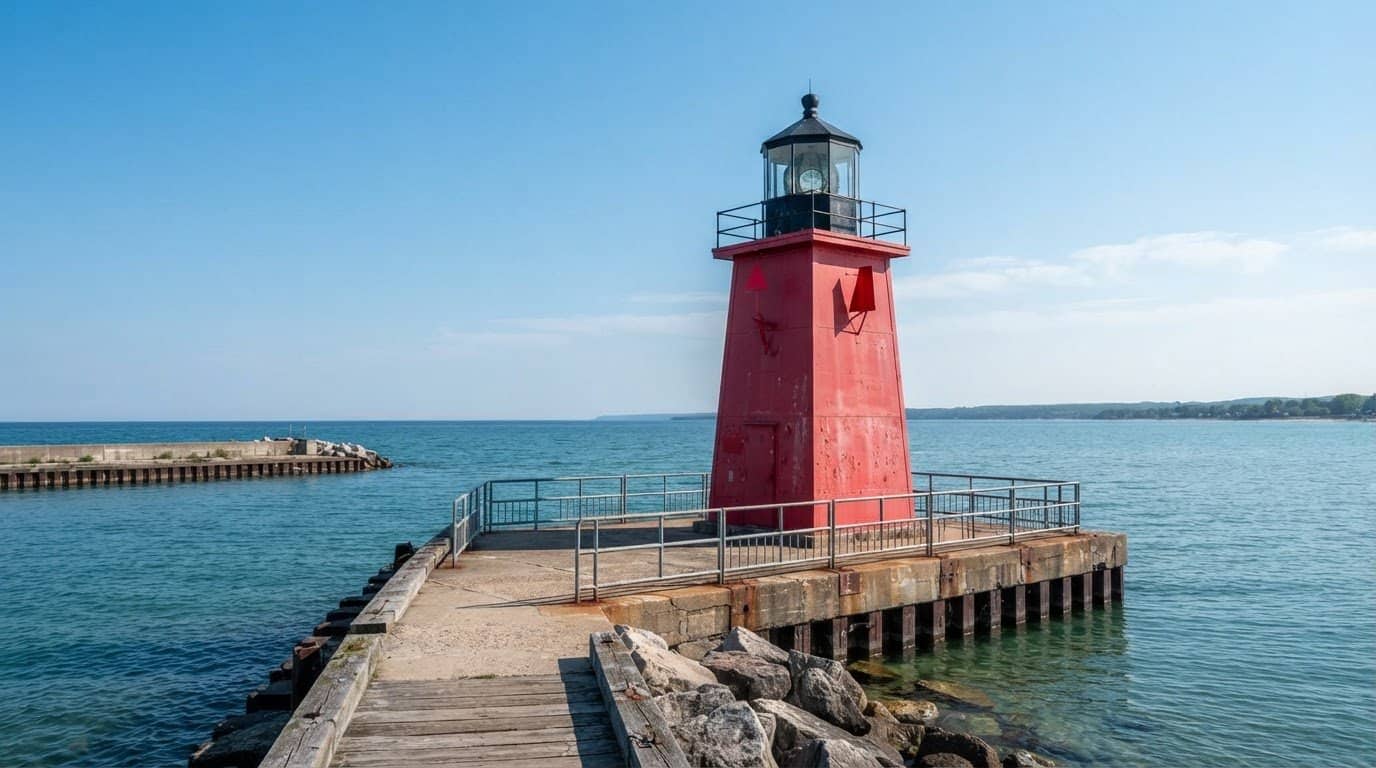
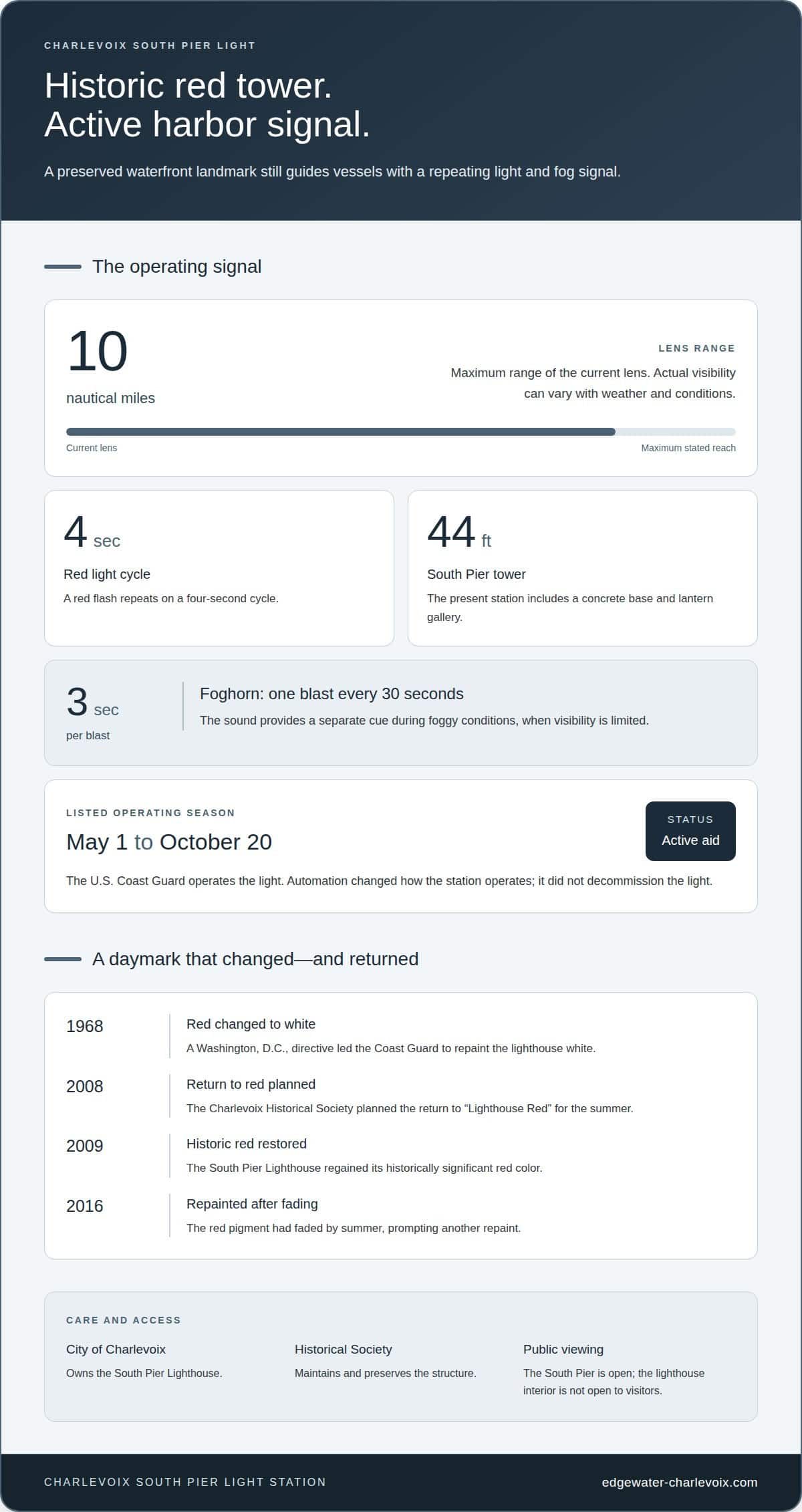
A daymark makes a lighthouse recognizable by daylight, when its lamp may not be visible. Charlevoix’s South Pier Light has worn different colors over time. Its original red daymark remained until 1968, when a directive from Washington, D.C., led the Coast Guard to paint it white. That change replaced a familiar local landmark’s historic appearance with a more uniform one. The Charlevoix Historical Society later planned a return to “Lighthouse Red” in the summer of 2008. The lighthouse regained its historically significant red color in 2009. By the summer of 2016, however, the red pigment had faded, so the structure was repainted.
The South Pier Lighthouse and North Pier light are distinct structures. The original lighthouse stood on the north pier before moving to the south pier in 1914; that same year, a new steel skeletal tower was built on the North Pier. The current South Pier station features a 44-foot tower, a concrete base, a lantern gallery, and the original cast iron lantern, reused when the wooden tower was dismantled.
The South Pier structure’s changing appearance reflects its working history as well as preservation efforts. After the Coast Guard’s 1968 color change, the return to red restored a historically significant daymark. Fading pigment prompted another repaint in 2016. The distinction matters: the North Pier light has its own history, including a 60-foot open metal structure removed in the mid-1980s and replaced by a shorter light. The red tower visitors recognize is on the South Pier.
Today, the City of Charlevoix owns the South Pier Lighthouse, the Charlevoix Historical Society maintains and preserves it, and the U.S. Coast Guard operates its light. The lighthouse stands at the harbor entrance, where the Pine River connects Lake Michigan and Round Lake. Visitors can reach it from Charlevoix’s Lake Michigan Beach. The South Pier is open to the public, but the lighthouse itself is not open for entry.
Seen from the shore, the red daymark helps distinguish the South Pier structure against changing skies and water. Its story also connects color to place: white marked the 1968 Coast Guard directive, while “Lighthouse Red” recalled the earlier appearance. The Historical Society’s plan in 2008 preceded the 2009 restoration. The later 2016 repaint addressed faded pigment, keeping the landmark’s restored color visible along Charlevoix’s waterfront.
Current light and lens
The Charlevoix South Pier light remains an active aid to navigation. Its current lens has a maximum range of 10 nautical miles. The light flashes red on a four-second cycle, giving vessels a repeating visual signal near the harbor entrance. That measured rhythm distinguishes the light’s present function from the lighthouse’s historic appearance. The lens continues to serve navigation, while the red flash provides its recognizable nighttime characteristic.
The South Pier is open to the public, but visitors cannot enter the lighthouse. The light itself is not open to visitors. From the pier, people can view the structure and its operating light from outside.
The light’s listed operating season runs from May 1 to October 20. The Charlevoix South Pier Light’s foghorn sounds one three-second blast every 30 seconds. Together, the red flash and audible signal help identify the station’s active role. The light and foghorn are distinct aids: one provides a visual cue, while the other sounds during foggy conditions.
Charlevoix’s lighthouse was automated in the mid-20th century. Automation changed how the station operated, but it did not decommission the light. It remains active today, with the U.S. Coast Guard operating the light. The distinction is useful: the historic building is preserved, while the navigation signal continues its practical work.
The current lens’s 10-nautical-mile maximum range describes its reach, not a guarantee of visibility in every condition. Weather and visibility affect what mariners can see. Its four-second flashing cycle gives the signal a defined repeating pattern, while the foghorn supplies sound when fog limits visibility. For visitors, the practical takeaway is simple: the pier offers an outside view, not interior access.
During the light’s operating season, a visit can pair the harbor landmark with other Charlevoix summer activities. The seasonal window, the red flash, and the recurring foghorn make the station’s present role easy to recognize from the waterfront.
National Register listing
The station joined the National Register of Historic Places in 2005. The listing recognizes the Charlevoix South Pier Light Station as a historic property. It also places the harbor landmark in a wider record of the nation’s historic places. For visitors, that recognition adds context to the lighthouse’s striking waterfront presence. Its story is part of Charlevoix’s maritime past, not simply a scenic backdrop.
The harbor itself helps explain the station’s historical setting. In 1868, a roughly 100-foot-wide channel was dredged between Lake Michigan and Round Lake. Work began in 1876 to replace piling in the Charlevoix channel with cribwork piers. These changes shaped the waterway the lighthouse would help serve. They also connect the station’s history to the development of the harbor entrance.
Preservation and public stewardship form another chapter. The National Park Service awarded the lighthouse to the City of Charlevoix in 2008. During the 2000s, the Charlevoix Historical Society restored the structure in phases. These milestones show how care for the station developed alongside its historic recognition.
Later work continued to address the physical structure. Repairs to the concrete base and lantern gallery were completed in 2023. In 2024, Quinn Evans architects assessed paint problems and prepared repair specifications. The lighthouse then underwent interior and exterior blasting and repainting between September and October 2025. Each project focused on preserving parts of the station while its light remained an active navigation aid.
For a closer look at local lighthouse history, the Charlevoix Historical Society Museum at Harsha House presents exhibits on the lighthouse’s role and keeper life. The museum is at 103 State Street in Charlevoix. Its displays add human detail to the station’s historic record, including the daily life of the keeper and his family. Together, the National Register listing and preservation work connect the harbor’s maritime development with the people who maintained its light.
Replacement of the original tower
A defining chapter in Charlevoix South Pier Lighthouse history began with a wooden lighthouse on the North Pier. Built in 1885 to guide ships through Lake Michigan waters and into the harbor, the first structure stood 30 feet tall. In 1914, it was moved to the South Pier, while a new steel skeletal tower was built on the North Pier.
The wooden South Pier tower deteriorated over time. A replacement decision followed in 1947, and the present lighthouse was built in 1948. Its tower rises 44 feet. The documented account gives the construction year and structural details, but does not name an individual designer or builder.
One notable feature carried through the change. Workers reused the original cast iron lantern when they dismantled the wooden tower. The replacement also received the original fifth order lens in 1948. Retaining these components connected the new structure to the earlier station, even as the tower itself changed.
The station’s access route also evolved. The elevated wooden walkway built in 1885 measured 750 feet, linking the tower with shore access across the pier. After the wooden walkway deteriorated, a metal one replaced it in 1904. That replacement measured 720 running feet, preserving the connection between shore and lighthouse.
Seen together, the reused lantern and lens reveal how the 1948 tower carried parts of the earlier station forward. This continuity is an important thread in Charlevoix South Pier Lighthouse history, linking the original wooden structure with the landmark that stands today.
For a Charlevoix visit shaped by waterfront scenery and local history, plan a stay in Charlevoix.
Edgewater Inn
Located right here in Charlevoix, Edgewater Inn offers a welcoming local base for enjoying the waterfront and exploring regional landmarks such as the historic Charlevoix South Pier Lighthouse. After tracing the tower’s changes, active light, and preservation story, a stay at this local destination lets you take in the harbor setting at a more leisurely pace.
Choose a One Bedroom Suite or Two Bedroom Suite for a private, residential feel during your Charlevoix visit. For couples planning a celebration in a scenic waterfront setting, Edgewater Inn’s local Wedding Venue Packages offer a way to make the occasion memorable.
To plan your Charlevoix stay or discuss a wedding, contact Edgewater Inn.
Make Charlevoix Part of Your Next Escape
Let your curiosity about the Charlevoix South Pier Lighthouse’s history inspire you to experience the harbor at an unhurried pace. Rather than treating the landmark as a single stop, leave time to enjoy the changing views, the movement of the water, and the details that make a place memorable. A thoughtful visit connects local heritage with the simple pleasure of spending time beside Lake Michigan.
Plan around the kind of visit you want, whether that means a quiet getaway or a gathering shaped by the waterfront setting. Give yourself time to explore at your own pace and take in the area’s distinct character. Edgewater Inn can be part of your stay, offering a welcoming place to return to after a day of discovery.
Reach out to Edgewater Inn to start planning your Charlevoix visit. Your next memorable waterfront escape can begin with a simple plan.
Frequently Asked Questions
When was the Charlevoix South Pier Lighthouse built?
The current Charlevoix South Pier Lighthouse was built in 1948. That date refers to the present tower, not Charlevoix’s first lighthouse, which was built in 1885 on the North Pier. The earlier structure later moved to the South Pier in 1914, making the station’s story a sequence of distinct towers and locations rather than one unchanged building.
What lighthouse or beacon stood on Charlevoix’s south pier before the current lighthouse?
Before the present tower, the South Pier carried Charlevoix’s original wooden lighthouse, moved there from the North Pier in 1914. The first structure was a 30-foot wooden tower, and its story predates the current 1948 building. This distinction helps separate the lighthouse transferred south from the steel skeletal light built on the North Pier in 1914.
Why was the Charlevoix South Pier Lighthouse built, and what role did it play in Lake Michigan navigation?
It was built to guide ships through Lake Michigan waters and into Charlevoix harbor. The light marked the entrance where vessels approached the Pine River channel, connecting Lake Michigan with Round Lake. A roughly 100-foot-wide channel was dredged there in 1868; the lighthouse served as a visual aid in this working passage, rather than simply as a harbor ornament.
Has the Charlevoix South Pier Lighthouse been restored or relocated?
Yes. The original tower moved from the North Pier to the South Pier in 1914; the current tower replaced the deteriorated wooden structure in 1948. Restoration is a separate part of its story: the Charlevoix Historical Society carried out phased work during the 2000s. The City of Charlevoix owns the lighthouse, while the Society maintains and preserves it.