The advertised room rate may not reflect every charge you pay, and fees may apply even if you don’t use the amenities they cover. Understanding hotel resort fees in Michigan means comparing the total stay cost, not just the room rate; on the market, resort fees are typically around $33 per day.
It’s understandable to want a clear picture of what you’ll pay before settling into a lakeside getaway. A separate fee can affect your budget, especially when it’s unclear what it covers or whether you can avoid or negotiate it.
This guide explains what resort fees are, how hotels charge them, what amenities they may cover, and how costs can vary. You’ll also learn how to compare the full price, look for potential savings, and decide whether a fee makes sense for your stay. With the details in view, you can plan with greater confidence and avoid surprises on your bill.
Key Takeaways
- Compare the full stay total, not just the advertised room rate, so added nightly charges don’t catch you by surprise.
- Learn how resort fees differ from government taxes and why a fee may still apply when you don’t use the amenities.
- Look closely at what a fee covers and whether those features matter to your plans.
- Explore ways to reduce or avoid fees, including options that may apply to certain award bookings.
- Use the property’s location, accommodation style, and included comforts to decide whether the overall stay offers value for you.
1. What are resort fees?
Resort fees are mandatory hotel charges added to the cost of a stay, often for amenities or services. Under federal upfront-price rules, mandatory resort fees must be included in the total advertised price. The fee may still appear as a separate line during booking, so compare the total before paying.
Understanding hotel resort fees starts with distinguishing disclosure from legality. A federal upfront-price disclosure rule doesn’t make mandatory resort or destination fees illegal. Instead, it requires covered lodging offers to show the total price, including mandatory fees, rather than highlight a lower rate that excludes them.
For a concise overview of hotel fees and how travelers assess them, watch this NerdWallet video:
The FTC’s Junk Fees Rule went into effect in May 2025. It prohibits bait-and-switch pricing that hides the total price of hotels, vacation rentals, and live events. For hotel booking, the practical distinction is between a mandatory fee and an optional purchase: required charges belong in the total shown, while optional services aren’t automatically part of that price.
Earlier FTC guidance also addressed hotel rate quotes. In 2012, the FTC advised 22 hotel operators that online rate quote totals excluding certain fees may need updating to comply with FTC regulations. The agency’s concern was that a low initial quote could leave travelers without a clear view of the amount they would pay.
That guidance didn’t declare resort fees unlawful. In 2012, an FTC attorney said hotel resort fees weren’t illegal if disclosed. The key issue for a guest is whether the price presentation makes the mandatory charge clear before completing the booking, rather than revealing it only after choosing a room.
When booking your stay, whether considering Edgewater Inn or another property, compare the total price shown for the same dates and room type throughout the booking process. A rate that looks lower at first may not be the better value if a required resort fee appears later. Keep the final price and fee breakdown together when comparing direct bookings, loyalty programs, or other offers.
2. What resort fees are and how they are charged
A resort fee is a lodging charge added to the room rate, commonly billed nightly and per room rather than per guest. That total applies even when two guests share one room, because the fee is typically room-based.
Hotels set these charges, and the label can vary. A property may call one a destination fee, amenity fee, or resort fee. The name alone doesn’t tell you what it covers. Compare the fee description, how often it applies, and the complete reservation total before choosing a room.
Hotels may bundle access to amenities or services into a mandatory nightly charge. By contrast, an optional or per-use charge applies only when a guest chooses a service, such as a paid activity or rental. Check whether the item appears as required in the booking total or as an optional purchase. This distinction clarifies which charges are part of the room cost.
A fee can substantially increase the effective room rate. Multiply the nightly charge by the number of nights, then compare that amount with the room rate and other required charges.
Why do hotels charge these fees? A bundled fee lets a property collect for shared services through a recurring room charge instead of asking guests to pay separately for each included amenity. It can also make the initially displayed room rate look lower if the full required amount isn’t clear at the start of booking. The total, not the first figure, shows what you’ll pay.
Are resort fees refundable if hotel amenities are unavailable or unused? Hotels may charge the fee even when guests don’t use the included amenities. If an advertised amenity is unavailable, keep the booking details and distinguish the issue from an optional, per-use charge when raising a billing concern.
Before booking, note the nightly fee, room count, length of stay, and total. Compare cash bookings with points bookings, but don’t assume points automatically remove separate charges. Hilton Honors and World of Hyatt waive resort fees on fully paid award bookings, a specific loyalty-program benefit that may affect your comparison. Check the total displayed for the reservation you’re considering.
3. What resort fees cover
A resort fee may bundle access to amenities and services that a hotel presents as part of the stay. Depending on the property, examples can include internet access, pool use, fitness facilities, parking, or recreational equipment. The label alone doesn’t tell you which services are included, so read the fee description alongside the advertised room rate and booking details.
Look for a specific description rather than assuming every facility is covered. If a listing names Wi-Fi, pool access, and beach equipment, treat them as distinct inclusions. Check whether access is limited by location, operating hours, or the number of devices. A broad phrase such as “resort amenities” offers less practical detail than named services.
Internet access illustrates why the fine print matters. If a resort fee covers internet access for two devices, that stated limit applies to up to two devices. A guest traveling with a laptop and phone can compare the limit with their needs. Don’t assume the same fee covers additional devices or premium internet unless the booking terms say so.
Some charges apply to a particular use rather than general access. For example, a hotel might include pool entry in its resort fee but charge separately for equipment rental or a guided activity. These are different cost structures: an included amenity is bundled into the room’s mandatory charge, while a per-use service is paid for when selected. Identify both before deciding whether the package suits your plans.
Michigan’s liquor liability coverage requirement is separate from guest amenities. Michigan law requires at least $50,000 in liquor liability coverage for active operation of a licensed business. That coverage protects a licensed business against certain alcohol-related liability; it is not a guest service like internet access or pool use. A resort fee description should be evaluated based on the amenities or services it identifies, not confused with a business’s insurance obligations.
To assess value, match each listed inclusion to something you expect to use. A traveler planning quiet days in the room may value reliable internet more than recreation access. A family planning to spend time at a pool may weigh that facility differently. Compare the fee description with your itinerary, then note which services are included and which come with separate charges.
Before completing a booking, review the itemized description for named amenities, access limits, and exclusions. Save the listing or confirmation showing what was advertised. If a billed amenity differs from that description, the reservation details give you a clear basis for discussing the discrepancy with the hotel.
4. Average resort-fee costs
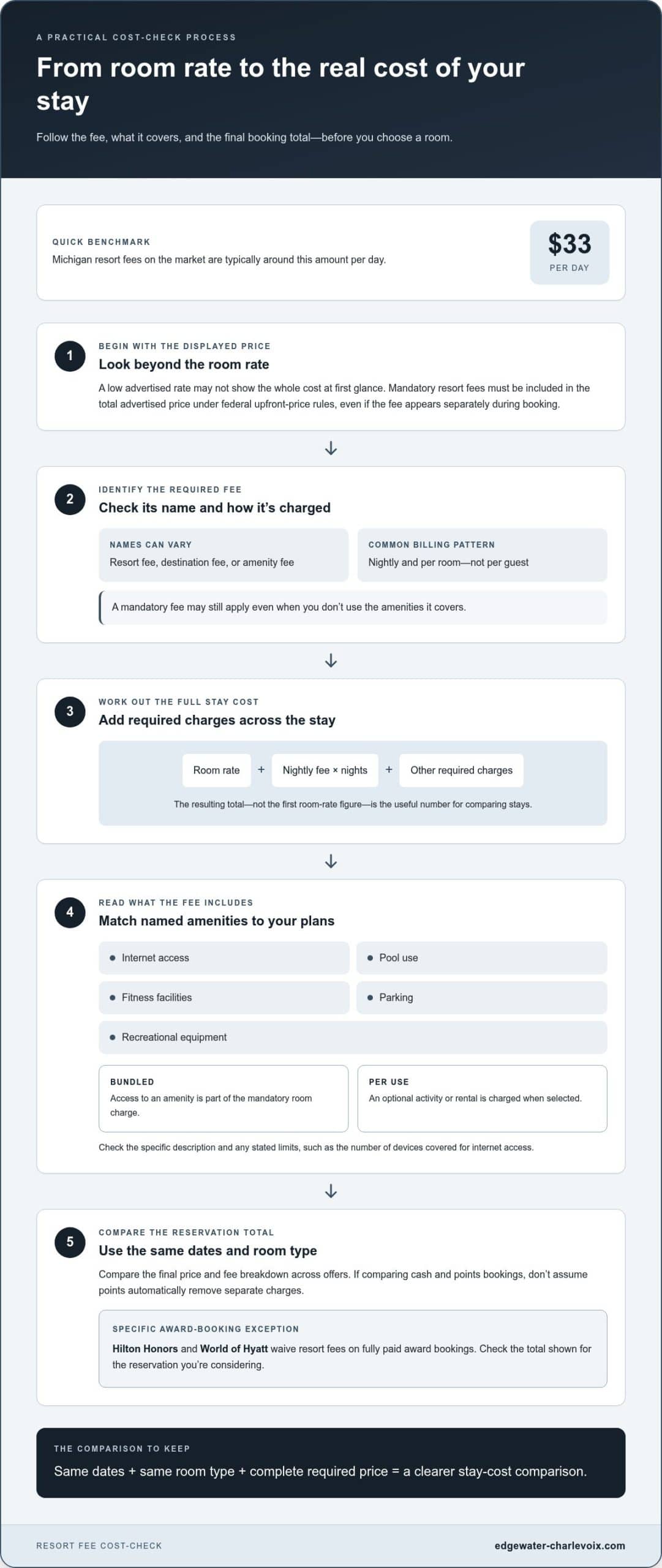
For a broad benchmark, hotel resort or destination fees are typically in the low-to-mid $30s per night, with a wider range of about $15 to $50. These are market estimates, not a guaranteed Michigan rate or a quote for a particular stay. A mandatory fee can vary by property, amenities, dates, and how the hotel structures its pricing.
NerdWallet analyzed 160 hotels worldwide with summer and fall check-in dates. Of those, 30 charged resort fees, averaging about $33 per night. That figure offers a useful reference point, but the sample covers hotels around the world, not a city-by-city Michigan survey. Treat it as context when weighing a quote, not a local average.
How do resort fees compare at Michigan hotels, resorts, and vacation rentals? Hotels and resorts may add a nightly resort fee, while vacation rentals can have separate charges, such as cleaning or pet fees. Michigan imposes a 6% state use tax on short-term rentals, including cleaning and pet fees, so compare each listing’s total rather than the fee label alone.
How much are resort fees at Michigan hotels, by city and property? There isn’t one fixed rate for each Michigan city; hotels set their own fees, and individual property pricing can differ. Use the broad $15 to $50 nightly market range as a comparison point, then calculate the actual total shown for your dates and room.
To compare offers fairly, match the travel dates, room type, guest count, and length of stay. Then list the room rate, mandatory fee, and government taxes separately. For example, a lower advertised rate may still produce a higher total if its required fee is larger. A like-for-like comparison shows which property costs less overall.
Also consider whether the stated amenities justify the added cost for your plans. A guest expecting to use a pool or included internet may value a bundled charge differently from someone who won’t use those services. Loyalty-program members can compare the cash total with a points option while checking how taxes and mandatory charges affect the final amount.
Before booking, save the itemized price for each property and compare the total for the full stay. This makes seasonal pricing, nightly charges, and rental fees easier to distinguish. A single nightly figure can obscure the cost of a longer visit, while the complete trip total shows what you’ll actually pay.
5. Avoiding or negotiating resort fees
Start with the total lodging price, not the room rate alone. Before entering payment details, compare the final price breakdown with your travel budget and note every mandatory fee. Data attributed to the American Hotel and Lodging Association indicates about six percent of hotels charge resort fees, so looking for stays without one may help you avoid this charge.
Use a consistent comparison method. Search the same destination, dates, room type, and guest count, then compare each stay’s full total. A lower advertised rate can become more expensive after destination fees are added. Record the room rate, mandatory fees, taxes, and optional charges separately. This makes differences between lodging offers easier to see and gives you a clearer basis for choosing.
Check loyalty-program terms before redeeming points. Hilton Honors and World of Hyatt waive resort fees on fully paid award bookings. That benefit applies to those specified award stays, not automatically to every points reservation or cash booking. Review the displayed total and booking terms before confirming, then compare the final amount with a paid reservation.
If a property charges a fee, ask whether it can be waived or reduced before booking. Make the request clear and specific: explain your dates, how the fee affects your budget, and whether you plan to use the amenities it covers. A polite request gives the hotel an opportunity to respond. Don’t count on a possible waiver until it appears in the reservation.
Use disclosure details to support a billing conversation. Save the booking screen, confirmation, and fee description, then compare them with the final bill. If the charge differs from the disclosed amount, point out the exact discrepancy and ask the hotel to review it. If an advertised amenity was unavailable, note the service and dates affected, then make a focused request about the related fee.
A credit card statement can help track the final transaction, but distinguish a temporary authorization from a completed charge. Compare the posted amount with your confirmation and itemized receipt before disputing a discrepancy. Keep the booking, fee disclosure, and hotel response together; these records make follow-up more precise than relying on memory.
When a fee remains mandatory, decide whether its included services fit your plans. For a quiet weekend, unused recreation access may add little value; for a stay built around the pool, it could matter more. Set a maximum total before booking, compare fees against your priorities, and choose lodging that fits your budget. For a waterfront stay, explore vacation lodging options.
Edgewater Inn: One Bedroom Suites
Edgewater Inn offers One Bedroom Suites for travelers seeking a home-like feel during a getaway. Each privately owned suite has a fully equipped kitchen and a private balcony with water views, offering space to unwind after a day by the water.
As you compare lodging totals, consider which comforts matter most to your plans. A suite with a kitchen and balcony may suit guests who value space to settle in and time to enjoy the views. Edgewater Inn also offers Two Bedroom Suites for stays that call for more room, as well as Wedding Venue Packages for couples planning a celebration.
For a closer look at the suites and stay details, visit Edgewater Inn online.
Plan a Michigan Stay That Fits Your Priorities
Let your next reservation reflect the kind of time away you want, whether that means quiet mornings by the water, room to gather, or a celebration in a scenic setting. Understanding hotel resort fees in Michigan can help you make a considered choice, but the best fit also depends on the experience you hope to create.
For a waterfront getaway, Edgewater Inn offers One Bedroom Suites and Two Bedroom Suites. Couples planning a celebration can also explore Wedding Venue Packages. These options give you a starting point for matching your stay or event plans with the setting you have in mind.
As you choose, keep your priorities in mind: the atmosphere you want, how you’ll spend your days, and the space that will make your visit comfortable. A little planning can leave more room to enjoy the shoreline, scenery, and unhurried moments that make a getaway memorable.
Contact Edgewater Inn to plan your stay, and take the next step toward time well spent by the water.
Frequently Asked Questions
What are resort fees?
Resort fees are additional lodging charges associated with a hotel stay, often tied to shared services or amenities. They’re separate from optional purchases, such as a paid activity, and may apply even when a guest doesn’t use what they cover. To assess a fee, review its description, when it applies, and whether it changes with room type or length of stay.
What is a resort fee at a hotel?
At a hotel, a resort fee is a property-set charge attached to a reservation, usually listed separately from the basic room rate. For example, a fee may be described as covering internet or pool access. Read the terms for that specific reservation: the name doesn’t guarantee which amenities are included, and access limits can affect whether the charge suits your plans.
What is the average resort fee?
Typical fees are also estimated around the low-to-mid $30s per night, with a broader market range of about $15 to $50. These figures are not Michigan-specific quotes; compare them with the total for your dates and property.
What’s the difference between a resort fee and a destination fee?
Usually, the difference is the label rather than a consistent distinction in what the charge means. A property might call a similar mandatory lodging charge a resort fee, destination fee, or amenity fee. The useful comparison is in the reservation terms: identify the amount, whether it applies each night, and what the description says it covers. Don’t infer included services from the label alone.
Why is my hotel bill more than the room rate?
Your bill may include mandatory lodging fees, government taxes, optional purchases, or a temporary deposit or incidental hold. A hold isn’t necessarily a completed charge, so compare your final itemized receipt with your card activity. Review the reservation confirmation against the bill, then separate nightly room charges, taxes, fees, and optional spending to identify any differences.
Which Michigan hotels and resorts charge mandatory resort or destination fees?
Fees vary by property and reservation, so a city name alone won’t tell you whether a charge applies. Review the total-price breakdown for the exact Michigan property, dates, and room type you’re considering. Compare the final amounts across your options and keep the itemized booking details; they show whether a fee is mandatory and how the property describes it.
What Michigan and federal rules require hotels to disclose resort fees?
The federal Junk Fees Rule took effect in May 2025. According to the Federal Trade Commission, it prohibits bait-and-switch pricing that hides the total price for hotels, vacation rentals, and live events. Earlier, in 2012, the FTC advised 22 hotel operators that online rate quotes excluding certain fees might need updating. These rules concern price disclosure, not whether a hotel may charge a fee.
Can Michigan hotel guests refuse or negotiate a resort fee?
Guests can ask whether a property will waive or reduce a fee, but there’s no guaranteed outcome. Make the request before booking and refer to the specific charge or included service. Some loyalty award bookings have fee waivers: Hilton Honors and World of Hyatt waive resort fees on fully paid award bookings. Check the terms for the reservation type and compare its final total with other options.